
A matter of care, a matter of justice | Caregivers in Peru
Dr. Claudia Vidal-Cuellar is a Peruvian Medical Doctor and researcher. She has worked as a primary care physician in the Peruvian Amazon, and has researched vulnerable populations including Amazonian Indigenous peoples, older adults and caregivers. In collaboration with the University of Oxford, The Belonging Research Lab and Partner’s in Health, Claudia led Caring for Caregivers, a project focused on understanding experiences of poverty and loneliness among informal caregivers in Lima, Peru. Claudia aims to highlight the use of art as a way of care and works to make the role of social connection as a dimension of poverty in caregiving settings more visible.
In my seven years of studying medicine, I was never really taught to think about the family caregiver: the person beside the patient, on the other side of the desk. That parent, son, daughter, neighbour or friend who accompanies and sustains the wellbeing of a loved one, often without adequate support or remuneration. The person who knows the part of the story that we cannot see from our hospital, office, or dataset. The person who carries much of the responsibility once we doctors sign and hand over a medical prescription.
Caregivers have their own worlds of experiences, knowledge and needs. Yet, they are not always seen, recognised or supported fairly, not only within health services but across systems and societies more broadly.
But how can we change this, and where should we start?
I don’t have all the answers. But I have learned meaningful lessons in the last couple of years, that I believe are worth sharing and that I hope encourage more people to keep questioning how to care better for caregivers, in whatever they do.
Why should we care about care?
Before joining the University of Oxford and the Belonging Research Lab, I had not fully appreciated how relevant, and surprisingly overlooked, the role of family caregiving really was. As I started reading more about the topic, I began to understand that caring about care means looking beyond how care matters for my own discipline or field.
Caregiving is present everywhere, as it may involve directly supporting someone else, but also many other tasks that are needed to sustain other people and the planet, like cooking, cleaning, and even participating in collective activities in the neighbourhood. Therefore, talking about care also opens a conversation about gender equality, social protection gaps, human dignity and, of course, belonging.
Just to give an example, unpaid care work accounts for around 9% of global GDP, with women undertaking a disproportionate share. In some countries, the contribution is even greater. In Peru, my home country, the contribution is estimated at up to 25% of GDP (ILO, 2025). At the same time, taking care of other people can come with significant personal costs. Caregivers are prone to experience social isolation, loneliness and limited opportunities to participate in social life, particularly when their responsibilities leave little time to look after themselves (WHO, 2025).
Recognising care therefore requires more than better health services or social policies for those receiving care. It also means asking how we create societies in which people who care for others are identified and given the opportunity to live with dignity, maintain social connections, and pursue their own aspirations.
Our experience
Inspired by these facts, we joined efforts from the University of Oxford, Partners in Health and the Belonging Research Lab, to do something about it. We designed a research project in Lima, Peru, to explore how multidimensional poverty and social connectedness are experienced by family caregivers of patients supported by Partners in Health. This included people taking care of patients with different needs, including early childhood, ageing, schizophrenia, HIV, tuberculosis, depression, dementia, disabilities and cardiovascular diseases.
We visited caregivers at their homes to conduct surveys and interviews on poverty and social connectedness. The experience was enlightening, and we will be sharing more about the data soon. But this time, I’d like to focus on what we decided to do beyond the data, when we realised that we had in our hands not only interview transcripts and survey results, but an opportunity to inspire more people to feel these experiences closer to their hearts and advocate for a fairer society for caregivers.
What if we started with a piece of paper?
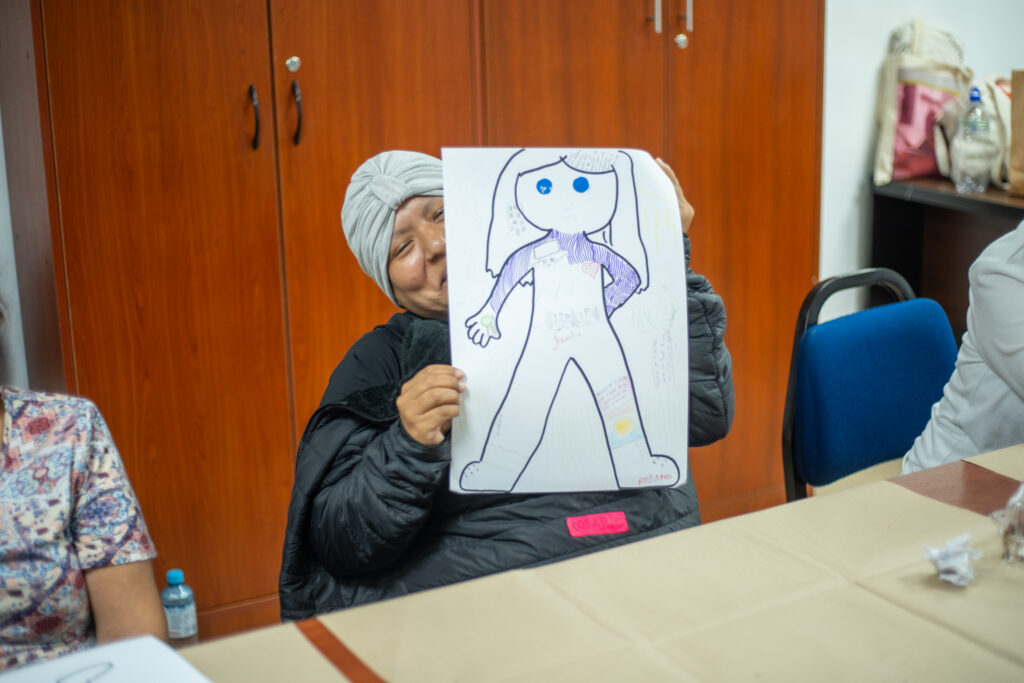
Photo Credit: Calle Perez
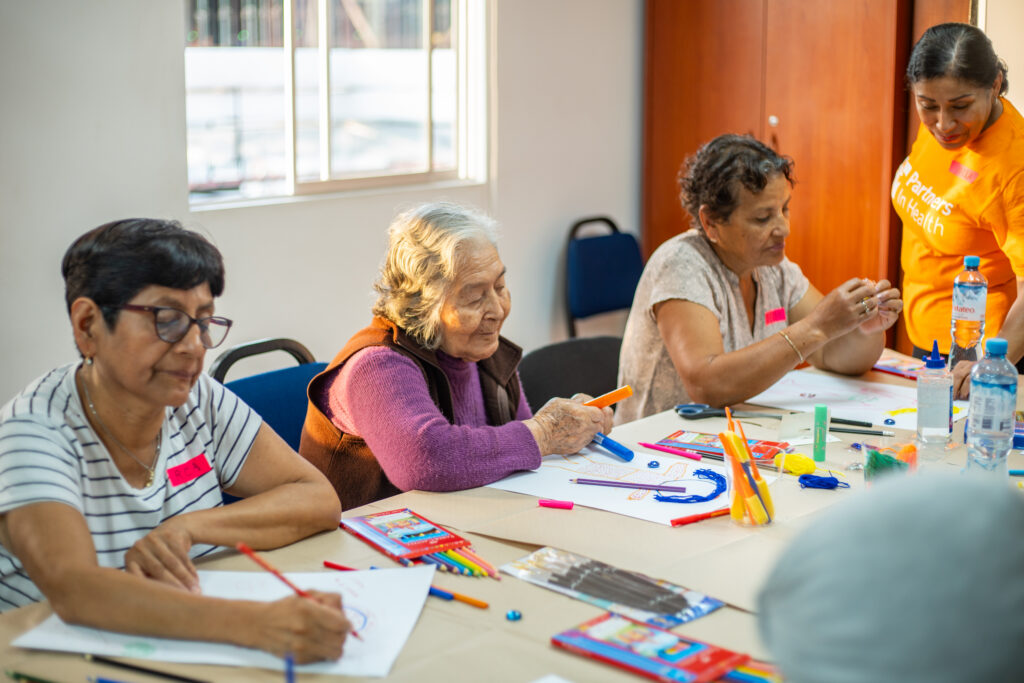
This question was behind Caring for Caregivers, a small advocacy initiative we embedded into the research project with the intention to bring a more human dimension to our research, while creating a space for caregivers to express themselves, share experiences and connect with others.
We invited 12 women who had participated in our research study to attend arts-based workshops. The selection of participants was informed by the data collected through the study, prioritising the ones with higher social isolation scores.
Art can offer a different language for expressing experiences that are not always easy to put into words. A drawing, a colour, a photograph or even a performance can communicate feelings, memories and relationships that might not emerge through a survey or a formal interview. It can also give people the freedom to decide what they want to express, and how. For us as researchers, it was an opportunity to listen differently and to learn from experiences beyond the questions we had initially set out to ask.
Sometimes, we underestimate what these small opportunities can mean. When so much of your time and energy goes towards looking after someone else, and on top of that you face hardship across multiple life dimensions like health, employment, education and household conditions, having a moment to turn your attention inwards can be meaningful in itself. Regardless of age, it can be an opportunity to rediscover creativity, to play, to feel curious and to connect with people who might understand parts of your experience.
See what happened when caregivers turned their attention inward
We also wanted these experiences to reach beyond the workshops themselves. Through an exhibition showcasing the caregivers’ artwork, we created another space for their expressions and perspectives to be seen and shared. In particular, we wanted to open a conversation with people working in healthcare and social care, inviting them to look beyond the patient and recognise the person who is often accompanying them. It was a way of bringing research and creativity together to make caregivers’ experiences more visible and accessible.
One step at a time
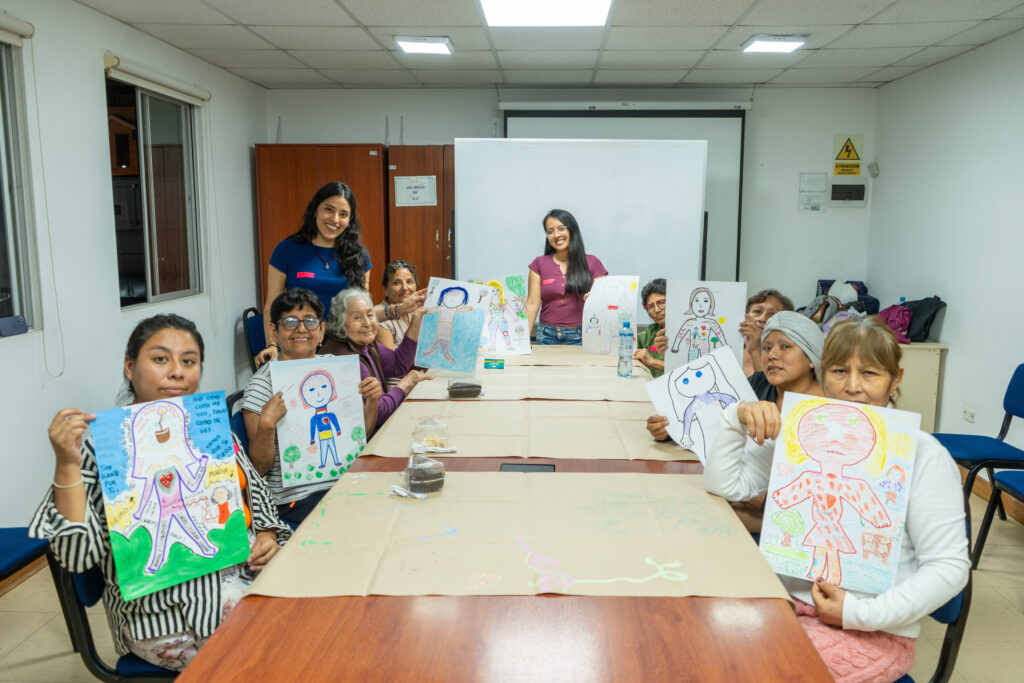
Photo Credit: Calle Perez
We know that four workshops and an exhibition will not change the structural inequalities that shape the lives of caregivers. They cannot replace better policies, social protection, financial support or more equitable care systems. And they shouldn’t have to.
But perhaps they can be a starting point. A way of opening conversations that have been overlooked for too long, bringing different disciplines and communities together, and thinking about care beyond the boundaries of a single discipline.
We hope that Caring for Caregivers can be adapted, replicated and sustained over time. But before thinking about how to scale an initiative, we need to make space for the conversation itself. We need to recognise that caregivers have their own lives, needs and aspirations, and that supporting them also means creating opportunities for them to connect, play, express themselves and simply be.
We may not yet have all the answers, but we can choose to keep caregivers’ realities close to our hearts, continue advancing evidence and advocacy, and work towards fairer societies for those who care.
Sometimes, simplicity, authenticity and creativity are the little doses of dignity we need.
To care for caregivers, we must first remember to see them. Because it’s not only a matter of care. It’s a matter of justice.
References
- International Labour Organization. (2025, August 28). Caracterización de las personas trabajadoras del cuidado en el Perú. Available from: https://www.ilo.org/es/publications/caracterizacion-de-las-personas-trabajadoras-del-cuidado-en-el-peru
- World Health Organization. (2025). WHO Commission on Social Connection. Available from: https://www.who.int/groups/commission-on-social-connection
Photo Credit: Calle Perez