
Uniform: The fashionable statement of faith
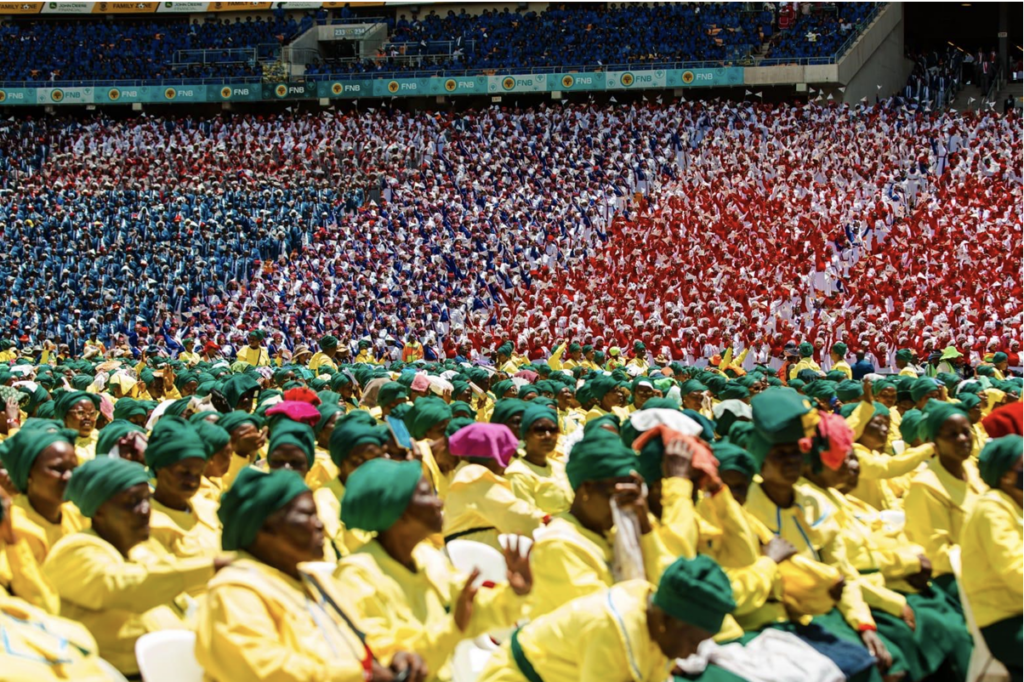
A rainbow of uniformed believers gathered at FNB Stadium in Johannesburg, South Africa for the annual National Day of Prayer, 2025. Source: Twitter/X: @MotsepeFoundtn
Phenyo Montsho is a Samuel Fellow in Belonging from South Africa. In partnership with the global non-profit Synergos, Phenyo’s research explores how spirituality shapes people’s sense of purpose and leadership roles.
When spiritual inner work is externalized to become a vehicle that unite communities and redress identity, power and belonging in Southern Africa
Sundays are auspicious in South Africa, a day of celebration where an extra dash of colour and energy lingers in the air. Every Sunday, the pothole ridden streets, sometimes flowing with raw sewage, transform into a runway of colourful ecclesial prowess, as the faithful journey to their designated church. In many South African languages, the word for “Sunday” is etymologically linked to church and worship. Moreover, the church is the first community that provides an intimate sense of belonging, coming only second to family in carving one’s identity.
According to Statistics South Africa, 85% of South Africans identify as Christians1. The country is amongst the few where believers have special attire reserved for worship. As membership spans across the country and into neighbouring countries, uniform is an active identifier of fellow believers; a literal fabric that weaves different people together.
Christianity carries a painful history in Africa. Much plunder through colonialisation was orchestrated with the complacency of European missionary churches. Despite this bitter past, the continent today accounts for the largest population of Christians in the world2, akin to a tree planted in misery which grew to bear sweet fruits.
Church uniform is a common practise in many churches in Southern Africa, but most dominant in African Initiated Churches (AICs); a network of churches across the continent that rejects European missionary theology, and instead embraces homegrown Christianity that celebrates and integrates African customs into the liturgy. The dawn of AICs in South Africa dates to the early 1900s3, giving rise to a variant of Christianity that better resonates with the local communities: for the people, by the people. The herding together in makeshift structures contrasted grand cathedrals in Europe, but remained to be a formidable haven from spiritual and political oppressive forces of the day. Many founders of AICs had little to no formal training and were community-sponsored. Hence, unlike missionaries, they had no fealty to aristocrats, but to the people. The gatherings grew to be community-built springs where all could find hope, healing, and empowerment amid a drought of isolation and oppression.
Today, AICs account for most Christians in Southern Africa, the largest being the Zion Christian Church (ZCC), which has millions of members. Furthermore, AICs continue to grow across the plains of Africa, in comparison to mainline Christian churches which are dwindling in membership in the so-called developed world.1 True to the etymological Latin root, church uniform speaks to people coming to be “one form”, curbing away the cracks that cause physical and spiritual divisions. Amidst the socio-political chaos of the early 20th century, church uniform became a symbol of power and unity; clothing the masses, otherwise stripped of their dignity, with pride.
Thanks to the uniform, a migrant worker could easily find their branch church in their vocational city, providing them with a home to belong to even when away from home. Many believers form part of their church community from a young age, growing physically and spiritually into their uniform as they age. As they grow, they have a greater presence in the church, and by extension, their community.
Church uniform is more than just an identifier, but a piece that communicates spiritual transformation. The attire is an extension of holiness, kept pristine by being washed and ironed frequently, as well as reserved solely for holy observations. Wearing uniform is an honour, an outward evidence of a continuous inner-work process where devotees tether to testify transformative tales.
Practises in AICs foster belonging, healing and restoration in recurring welcoming hymns in services, gathering at weddings and funerals, as well as intra-church conferences. Uniform is awarded after completion of a rite of passage, culminating in a baptism at a designated natural body of water.
Many AICs have natural sacred sites as well as associated pilgrimages for uniformed members, which strengthen strings of cohesion and belonging as they undertake the journey of empowerment together. Every New Year’s Day, members of the Nazareth Baptist Church undertake a sixty-kilometre pilgrimage wearing uniforms adorned with Zulu traditional attire. The church is synonymous with Zulu culture. In 2023 incumbent Zulu King, His Majesty Misuzulu KaZwelithini was baptised into the church, leading members to beam with both ecclesial and Zulu pride.

Zion Christian Church members dancing in their designated uniform and the signature star badge, Harare, Zimbabwe.
Source: Fidelis Manyange, Wikimedia
Vibrant music and dancing are yet another staple of AICs. Services, which may be numerous in a week, feature melodies in multilingual hymns, with a charismatic preacher and dedicated language-interpreter. Hymns tend to have a call-and-response tune, accompanied by clapping, and rudimentary instruments like drums and shakers made from repurposed materials. The flowy uniform aids in creating a harmonic spiritual choreography that can last an entire day or night.
In a country of twelve official languages, these measures create an accommodating space where unity reigns without encroaching on individual identity. Church becomes a platform where one taps into their gifts and purpose to contribute to society without their academic qualification, gender, or age being a barrier. Believers often credit their membership to a calling from God or ancestors, and use their spiritual gifts, which may include healing and prophecy to benefit fellow believers and communities alike. In a country with dilapidating facilities and a 33% unemployment rate,4 church participation is a necessary distraction to the otherwise hopeless outlook of the country.
As AICs continue to grow, they expand into sacred communities that welcome all to journey through life together. The uniform complements the call to stand together against a myriad of social and spiritual challenges, where the many come to be one; that is belonging.