
They came in from the cold, then somebody learned their name.
Myriame Francois is a Samuel Fellow in Belonging from the U.K. As an international development and communications professional whose work focuses on gender, public health, humanitarian response, and community engagement, her research with Warm Welcome Spaces focuses on community.
Britain built thousands of spaces to solve a cost-of-living crisis. They may have solved something bigger instead, and now risk being defunded for the wrong reasons.
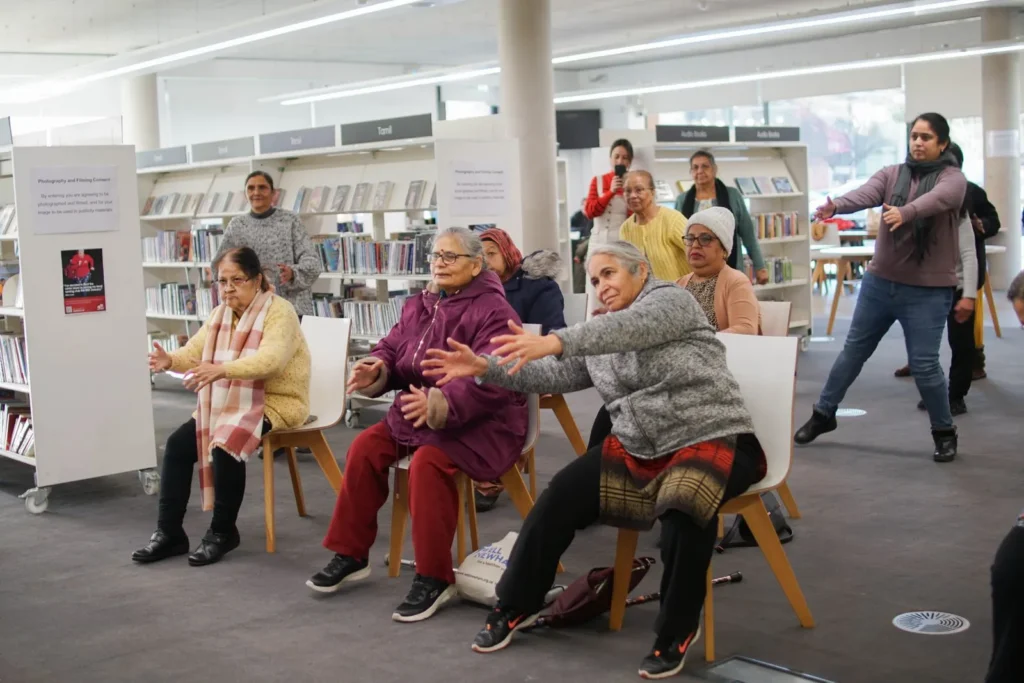
Ask anyone what a Warm Welcome Space is for and they’ll give you the answer printed on the tin: somewhere to get warm. In winter 2022, as energy bills tripled, thousands of church halls, libraries, cafés and community centres threw open their doors with essentially the same invitation: come in, it’s free, it’s warm.
Here’s my unpopular opinion. The warmth was only the invitation. It got people through the door, but something bigger happened inside the room. Community happened.
What kept people coming back, after the boiler panic left the news, wasn’t the radiator. It was being missed when they didn’t show up, someone remembering how they take their tea. Free heating alone won’t touch the loneliness this country is living through. But belonging can.
We’re at real risk of congratulating ourselves for solving one problem while another one keeps growing in the rooms we built to fix it.
Access is not belonging
We’ve built a solid vocabulary around access: ramps, hearing loops, translated leaflets, step-free entrances. All of it is necessary. But none is sufficient. Access unlocks the door; inclusion gets you a chair. But belonging wrestles with something harder: Do you have any say in where the chairs are placed?
john a. powell makes a similar case. In a 2019 essay, the director of UC Berkeley’s Othering and Belonging Institute writes that to belong is “not just to be a citizen or member in the weakest sense, but to be able to participate in cocreating the thing you belong to. This makes it different than inclusion.” In other words, being let into somebody else’s room, on their rules, still makes you the grateful guest.
Writing about the Black communities that raised her, bell hooks called these spaces of refuge and affirmation “homeplace”, spaces built mostly by women, where Black people reclaimed dignity and agency.
Both touch the same gap: being permitted into a space is not the same as having the power to shape it.
Here’s where I’ll show my hand. Most institutional “access and inclusion work” is excellent hospitality with a mission statement, and hospitality is something the host controls. You can be the most gracious host and still decide where the chairs go. Belonging, however, begins when the guest gets a real say in that decision. It’s slower and messier than hospitality, and it’s the “welcome” that survives a wet Tuesday in February.
What Warm Welcome already knows
To its credit, Warm Welcome saw this coming. In 2024 it began an inclusion cluster, with spaces and partners comparing notes on who was not yet in the room. That thinking now runs through its Inclusion Toolkit, built with more than 200 people who run its thousands of spaces.
Nearly three-quarters of people in the UK live within a 30-minute walk of one; only around a quarter know it. We’re not merely talking here about logistics problems. Much of the infrastructure exists. What’s often missing is the sense that a space is “for me”, rather than for “people in need” as an abstraction.
Rich, Warm Welcome’s Research Manager, aptly described the gap. In the campaign’s polling, people overwhelmingly agree these spaces ease loneliness. Yet when asked if the spaces are “for them”, a striking number say no. “People think, oh, that’s nice, but not for me,” he told me. They imagine the spaces are for older people, people who can’t heat their homes, or whoever the local church serves. That’s what access statistics miss.
Ria, who coordinates the network’s most engaged “Champion” spaces, described a guest who wanted to run a board-games evening and was simply handed a table and a weekly slot to host it. She also pointed to how much a space’s volunteers can influence the decision to walk in. One space in Birmingham, after recruiting bilingual volunteers from the community it wanted to reach, now serves people “who wouldn’t have been in the same room ten years ago.”
“For me” isn’t an invitation. It’s co-creation.
Helena, Warm Welcome’s Partnerships Manager, reaches the same conclusion: “Belonging is something you experience within. Inclusion is something you can be included in but not necessarily feel that you belong.” For Ria, belonging has a face and a name. A guest she met in Nottingham, whom I’ll call Anna, once said this was the last place anyone still knew her by name. Not the last place where she received help. The last place where somebody called her by her name.
Fund the chair, not just the boiler
This reaches past end-of-crisis press releases. The trap around Warm Welcome catches almost every well-meaning institution. Money and metrics readily count access; belonging is harder to fit into a grant application.
“There’s a lot of support for domestic use,” Helena told me, “but there is no funding for community organisations in terms of rising energy costs.” Anti-poverty charities have said as much since 2022: crisis response gets hard-wired into the voluntary sector, the funding doesn’t. Warm Welcome started as an answer to the energy crisis, and much of its funding still follows the thermometer. Solve that crisis, and you’ve solved the problem it was originally built for. Or so one would think. But the loneliness underneath won’t have read the press release.
So, here’s what I want funders to change: measure differently. Footfall counts access; progression from visitor to host tracks belonging. And organisations? Hand over the pen. A strategy rolled out to a network is inclusion, not belonging. Watch the language. “Beneficiary”, “guest”, “service user”: each ranks someone below the host. Try “member”. Try “host”. Hand someone the keys before they ask.
Winter always ends. Energy prices will rise and fall, and at some point, a minister will declare the crisis over, and a share of the funding that built this network will follow the headline out the door. The loneliness won’t have read that press release. It will still be there in May, on an ordinary Tuesday, because loneliness was never the emergency’s fault; the emergency just made it impossible to ignore. In Nottingham, Anna will still need that familiar place. So, keep funding the boiler, by all means. But build the next decade around the chair.
Note from the author: Everyone quoted here works with Warm Welcome’s central team. This autumn, I am trading the desk for the doorway. I’ll be spending time in the actual spaces with volunteers and regulars, listening and observing how belonging moves through the rooms. My travel diary will eventually find its way into a longer research paper. For now, this is the view from the centre. The room comes next.