
The Healing Arts: Belonging Research in Peru
Marianne Luyo is a Belonging Lab Research Fellow and Medical Doctor. She collaborates closely with the Faculty of Medicine at Cayetano Heredia University in Lima, and with partners at the University of Toronto. Her current projects focus on Venezuelan migrant women in Peru, navigating rupture, resilience, and re-rooting, examining how song, oral tradition, and creative ritual can restore belonging and dignity in contexts marked by displacement, and ongoing uncertainty.
In June, I presented our work at “The Healing Arts-Forging Alliances of Arts and Medicine” congress in Berlin organized by the International Society of Arts and Medicine (ISfAm). It brought together medical professionals, artists, researchers and students from different parts of the globe to share, discuss and reflect at the intersection of medicine, arts and health based on the evidence-supported understanding that health has to be addressed beyond the biomedical framework.
I noticed belonging was a transversal theme throughout the congress as arts offer concrete responses to loneliness and social disconnection. Arts-based activities designed to promote health and well-being create spaces in which people can feel, play, remember, imagine, express, relate to one another, give shape to their life stories, and find meaning.
It was truly an exceptional experience to witness a dialogue oriented towards the future of medicine and arts and be part of the conversation. At the Belonging Research Lab, we work from shared principles rooted in essential dimensions: people, place, power and purpose. Each dimension speaks from a different angle of what it means to belong, and addressed through the arts, they could help make care more capable of meeting the complexity of human beings within healthcare.
The feeling of belonging emerged as a question in many research presentations as being part of something greater than oneself, being listened to, or finding recognition and meaning with one another.
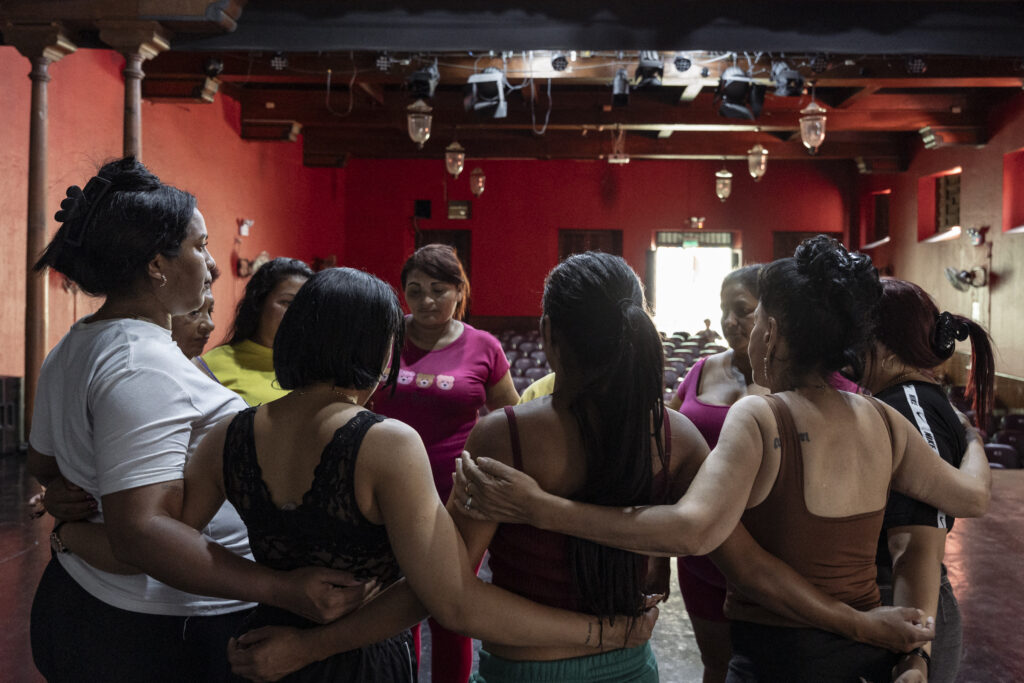
On June 20th, I gave a presentation on our research study “Embodied Creative Relational Inquiry with Venezuelan Migrant Women Sex Workers in Peru”. It took place within the Embodied Research panel. The study examined how ten Venezuelan cisgender women engaged in sex work in Lima, Peru, experienced and enacted belonging through arts-based workshops involving performance, singing, writing, movement, and play.
We noticed belonging was not static, but in constant flux, following a distinct rhythm, arranging and rearranging as social, emotional and spatial attachments shifted severely.
I like to think about belonging as rhythm. Rhythm comes from the ancient Greek rhythmos which means regular and recurrent movement, a flowing, a repetition. We find it in the seasons, in the circadian and sleep cycles, in music, in poetry. Within us. When we get back to it, as Victoria Santa Cruz in her “Ritmo, el eterno organizador” explains, it organizes life experiences and integrates us into a greater whole (body, nature, cosmos) transforming us. A subjective, collective integration. In the study, rhythm became visible in the singing, the breathing exercises, the voice attunement, the collective movement and writing.
An important contribution of this experience is how participants enacted belonging through artistic practice which created opportunities to coordinate with one another through voice, breath, and bodily presence. These moments of synchronization made visible dimensions of belonging that may have been difficult to access through conventional qualitative methods such as interviewing or focus groups.
As a medical doctor with experience in public health, what struck me the most about this study was its capacity to hold the ambiguity and complexity of being human. This is why it matters. Participants’ bodies and sensations took shape as plays, poems, letters, collective singing, dialogue.What is key about this knowledge is its capacity to transform rather than to extract. To know one’s interior world through and interpersonal connection is to transform and be transformed.
What surprised us was how, through creative practice, participants reconnected fractured identities associated with home. It allowed them to remember the past, enact connection in the present and imagine hopeful futures. It put chaos into a very specific order, one that belonged to each participant and to the collective of shared experiences, and made it visible. It was relevant because it approached memory not only from pain but from an intention of creation.
Finally, a question that kept coming back for the team was what is the relevance of arts for public health? The congress answered many layers of this question. Arts are part of providing care. Healthcare systems all over the world dealing with burn out, time pressure, technological demands and rising chronic disease incidence, can find in the arts a way to strengthen people’s agency to care for their own healing processes, and for healthcare professionals’ capacity to deepen the prevention and community health work. The role of public health is to improve and sustain human beings and their communities’ health, and we are increasingly understanding that people’s capacities to maintain and re-create a sense of belonging is part of our well-being.
I would like to highlight that research at this intersection develops strongly with collaborative work. Our Belonging Research Lab advanced and broadened what belonging research is capable of doing through mentorship and support. We had an amazing team of local artists: Micaela Távara, a performance artist focused on theater pedagogy and using art as a tool for social transformation, particularly in raising awareness and combating gender-based violence, and Alli Palma, an experienced musician and music teacher who led the collective singing sessions.
We also had the support of our local base organization partner, Miluska Vida Dignidad, which protects human rights of sex workers in Peru, advocating for labor recognition, decriminalization and better quality of life. Research teams at Universidad Peruana Cayetano Heredia and University of Toronto were key for the project’s creation and development, and we built upon existing community relationships and prior knowledge generated through the larger project Estamos Aqui (We are here) led by Dr. Amaya Perez-Brumer and Dr. Alfonso Silva-Santisteban in Colombia and Peru. Their mentorship throughout the project was essential every step of the way.
One last riveting idea I was left with at the congress was the image of Medicine and Art as two rivers merging to create a new language, not to prove one to the other, but to build conditions for them to keep meeting within our everyday practices of care. For them to keep meeting anew.
References
- Samuel, K. (2022). On belonging: Finding connection in an age of isolation. Abrams Press.
- Santa Cruz, V. (2004). Ritmo: El eterno organizador = Rhythm: the eternal organizer. Ediciones COPÉ, Departamento de Relaciones Públicas de PetroPerú.